
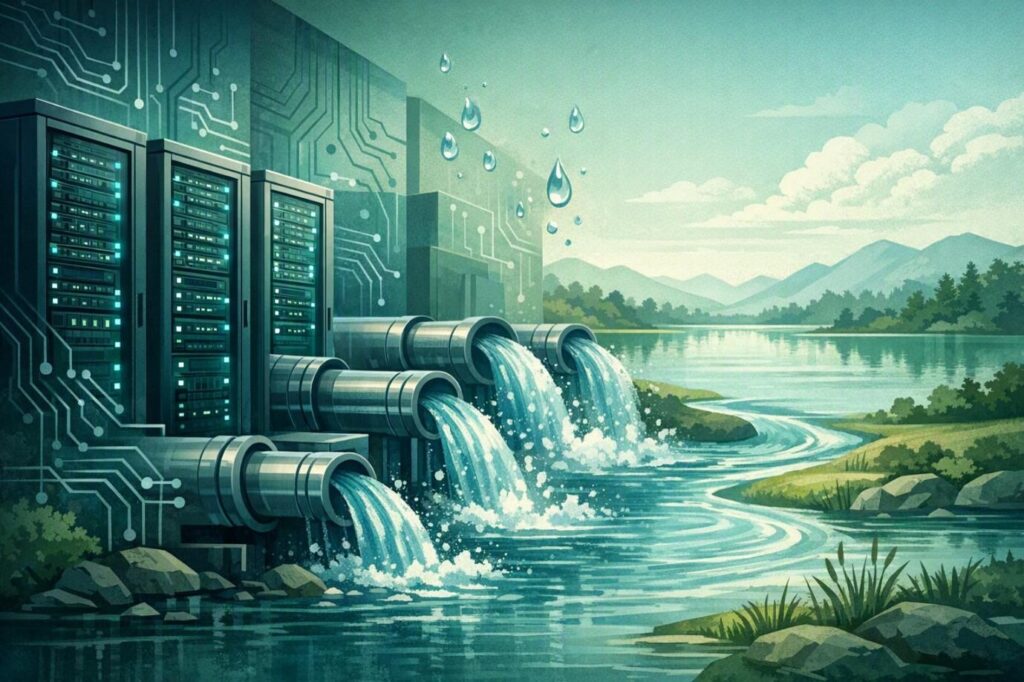
Artificial intelligence is rapidly transforming the way businesses operate, communicate and serve clients. From drafting emails and analysing financial data to enhancing customer service, AI tools have become increasingly integrated into daily workflows. However, behind every AI query lies an often-overlooked environmental cost, water consumption.
A recent article published by Space Daily highlights a growing concern among researchers and sustainability experts: the significant amount of water required to support the global infrastructure that powers artificial intelligence. While AI offers immense productivity benefits, its environmental footprint is becoming an important consideration for businesses, investors and policymakers alike.
The Surprising Water Cost of an AI Query
According to research cited in the article, generating a single 100-word email using a large language model can consume approximately 500 millilitres of water, roughly the equivalent of a standard bottle of water. This estimate includes both the water used to cool data centre servers and the additional water required to produce the electricity that powers them.
While an individual query may seem insignificant, the scale of global AI adoption changes the equation dramatically. Millions of users interact with AI platforms daily, generating enormous computational demand and increasing pressure on the data centre infrastructure that supports these systems.
Why AI Requires So Much Water
Artificial intelligence systems rely on powerful data centres filled with high-performance processors that generate significant heat during operation. To maintain safe operating temperatures, many facilities use evaporative cooling systems that depend heavily on water. As water evaporates, it removes heat from the equipment, ensuring reliable performance of the computing infrastructure.
As AI models become larger and more sophisticated, the need for computing power, and consequently cooling capacity, continues to grow. New AI-focused data centres are significantly larger and more energy-intensive than many traditional cloud-computing facilities, creating increased demand for both electricity and water resources.
A Growing Global Challenge
The article highlights estimates suggesting that global AI infrastructure could require between 4.2 and 6.6 billion cubic metres of water annually by 2027 if current growth trends continue. At the upper estimate, this would equate to nearly half of the United Kingdom’s annual water withdrawal.
Major technology companies have already reported rising water consumption associated with data centre operations. Research referenced in the article indicates that water usage by large technology providers has increased substantially over the past several years as investment in artificial intelligence accelerates.
Of particular concern is the fact that a meaningful portion of this water demand originates from regions already experiencing water scarcity. In some areas, local communities, agriculture and industry may increasingly compete for finite freshwater resources as data centre development expands.
What This Means for Investors
Environmental, Social and Governance (ESG) considerations continue to play an increasingly important role in investment decision-making. While much attention has historically focused on carbon emissions, water usage is emerging as another critical sustainability metric.
Investors are beginning to assess how technology companies manage water resources, particularly as AI becomes a key driver of future growth. Businesses that demonstrate responsible resource management, invest in water-efficient technologies and improve transparency around environmental impacts may be better positioned to navigate future regulatory and sustainability challenges.
Balancing Innovation and Sustainability
There is little doubt that artificial intelligence has the potential to create significant economic value and solve complex global challenges. AI may contribute to advancements in climate modelling, water management, healthcare and agricultural efficiency. However, as adoption accelerates, balancing technological innovation with responsible resource stewardship will become increasingly important.
For investors and financial advisers, this development serves as a reminder that sustainable investing is continually evolving. Understanding the environmental implications of emerging technologies will be an important part of assessing long-term risks and opportunities in the years ahead.
Source: Adapted from*”Writing a Single 100-Word Email with ChatGPT Consumes Approximately the Volume of a Standard Bottle of Water”* by the Space Daily Editorial Team, published 3 June 2026. Available at: https://share.google/B9kIi5w6RBf1AygcW
Disclaimer: This article is intended for informational purposes only and does not constitute financial, investment or sustainability advice. Readers should conduct their own research and consult appropriate professionals when evaluating investment decisions.