
Technology continues to evolve, but cybercriminals have discovered that the easiest way into a business or personal account is often not through sophisticated hacking tools, but through people. Understanding how these attacks happen and how to protect yourself is one of the most important steps you can take to safeguard your finances, identity, and personal information.
It’s No Longer Just an IT Problem
When most people think about cybercrime, they imagine hackers breaking through complex security systems. The reality is often much simpler. Cybercriminals frequently target human behaviour instead of technology.
Phishing emails, fraudulent payment requests, fake invoices, identity theft, and business email compromise scams remain among the most successful forms of cybercrime because they exploit trust, urgency, and distraction.
Attackers may pretend to be:
- Your bank
- A financial adviser
- A supplier or service provider
- A colleague
- A family member
- A government institution
Their goal is simple: convince you to click a link, open an attachment, disclose sensitive information, or transfer money.
In many cases, a single email or text message can bypass the most sophisticated cybersecurity technology simply because it appears legitimate.
Why the Human Factor Matters
Cybercriminals understand how people make decisions.
They create messages that appear urgent:
“Your account has been suspended.”
“Payment must be made immediately.”
“Please update your banking details.”
“Your parcel cannot be delivered.”
When we’re busy, distracted, or under pressure, it’s easier to overlook warning signs.
Before acting on any unexpected request, ask yourself:
- Was I expecting this communication?
- Does this request seem unusual?
- Is there pressure to act immediately?
- Have the banking details changed?
- Can I verify this using a trusted contact number?
A few minutes of verification can prevent significant financial losses.
Your Password Is Often the First Line of Defence
One of the most common ways cybercriminals gain access to accounts is through weak passwords.
Many people still use simple passwords such as:
❌ 123456
❌ password
❌ Password1
❌ Welcome123
❌ Summer2026
❌ CompanyName1
These passwords are predictable and can often be cracked almost instantly by automated software.
Even worse, many people reuse the same password across multiple websites. If one website suffers a data breach, criminals will attempt to use those same credentials on banking, email, social media, and investment accounts.
What Makes a Strong Password?
A strong password should include:
✅ At least 14-16 characters (longer is better)
✅ Uppercase letters (A-Z)
✅ Lowercase letters (a-z)
✅ Numbers (0-9)
✅ Special characters (! @ # $ % ^ & * ?)
✅ No personal information such as names, birthdays, ID numbers, or business names
Rather than creating a short, difficult-to-remember password, consider using a passphrase.
The longer passphrase is easier for the user to remember and dramatically harder for criminals to crack.
Password Length Is More Important Than Most People Realise
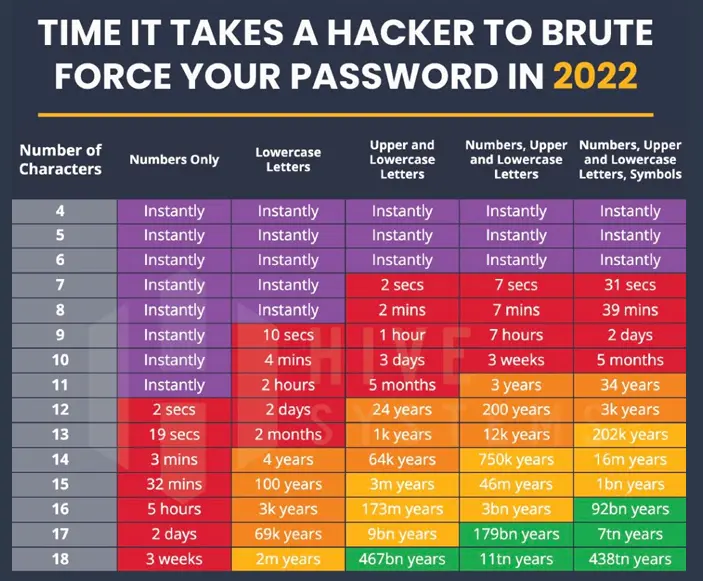
The password-cracking timeline below demonstrates how rapidly weak passwords can be compromised.
Approximate Time to Crack
| Password Type | Characters | Time to Crack |
| Lowercase only | 8 | Instantly |
| Upper and lowercase letters | 8 | 2 minutes |
| Letters, numbers and symbols | 8 | 39 minutes |
| Upper and lowercase letters | 12 | 24 years |
| Letters, numbers and symbols | 12 | 3,000 years |
| Letters, numbers and symbols | 16 | 92 billion years |
The difference between an 8-character password and a 16-character password is staggering.
Adding just a few extra characters can turn a password that takes minutes to crack into one that would take billions of years using current brute-force techniques.
Don’t Forget Multi-Factor Authentication (MFA)
Even the strongest password can be stolen through phishing, malware, or a third-party data breach.
This is why Multi-Factor Authentication (MFA) is so important.
MFA requires a second verification step, such as:
- A code sent to your phone
- An authentication app
- A biometric verification such as fingerprint recognition
If a criminal obtains your password, MFA can often stop the attack before access is granted.
Simple Steps to Reduce Your Cyber Risk
Every individual and business can significantly improve their cybersecurity by adopting a few simple habits:
✔ Use a unique password for every account. (we know this is the greatest challenge most of us have so be systematic and use a fail-safe method to store your passwords)
✔ Enable Multi-Factor Authentication wherever possible.
✔ Use a reputable password manager.
✔ Verify any banking detail changes telephonically.
✔ Be cautious of unexpected attachments and links.
✔ Keep software and devices updated.
✔ Never provide passwords or verification codes to anyone.
✔ Take an extra moment to verify urgent requests.
Final Thoughts
Cybersecurity is no longer solely a technology issue. It is a people issue.
The most advanced security systems in the world can be undermined by a single click on a malicious link or a hurried approval of a fraudulent payment request. However, informed and vigilant individuals remain one of the strongest defences against cybercrime.
Ultimately, the goal is not to become a cybersecurity expert. It is simply to develop good digital habits, think before you click, use strong passwords, and verify unusual requests.
Remember: Cybercriminals don’t always hack computers. More often, they trick people. The good news is that awareness, caution, and a few simple security practices can make you a much harder target.