
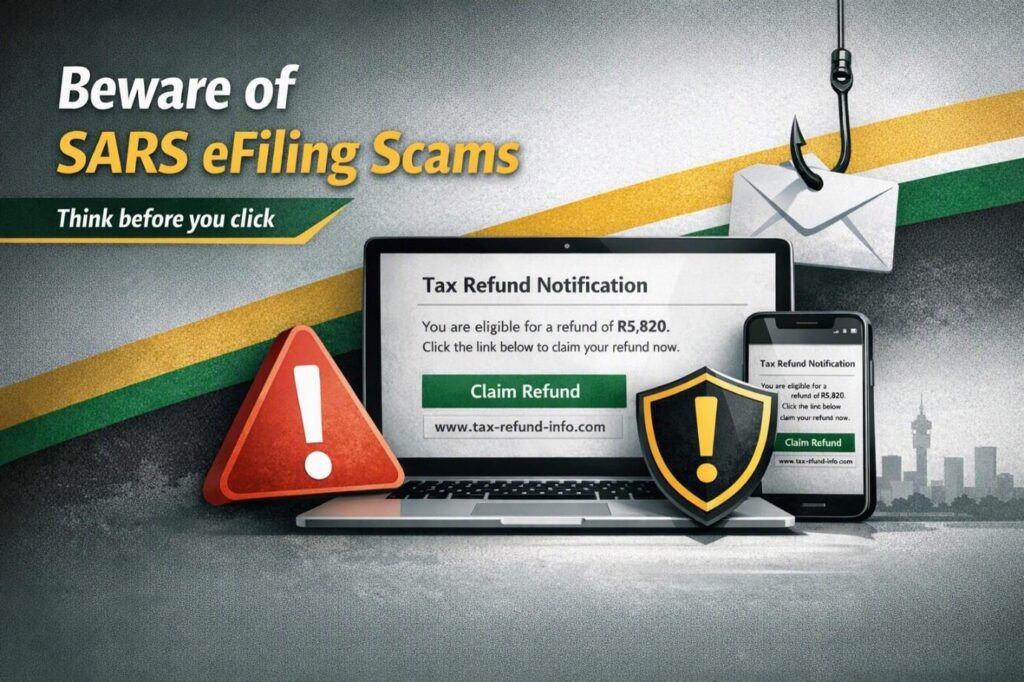
As tax season continues, cybercriminals are actively targeting South Africans with convincing SARS-themed phishing emails, SMS messages, and fake websites. These scams are designed to steal personal information, banking details, passwords, and eFiling credentials.
At Wealth & Asset Financial Services, we encourage all clients to remain vigilant and verify any tax-related communication before taking action.
What is a SARS Phishing Scam?
A phishing scam occurs when criminals impersonate SARS and send communications claiming that:
- A tax refund has been approved
- Additional tax must be paid urgently
- Your eFiling account has been suspended
- Personal information requires verification
- Your banking details need updating
The goal is to trick taxpayers into clicking malicious links and providing sensitive information.
What SARS Will Never Do
According to SARS, the organisation will never:
❌ Request personal, banking, credit card, or account information through email, SMS, or social media.
❌ Send hyperlinks to websites where you are asked to provide passwords or banking details.
❌ Demand payment through unofficial channels or personal bank accounts.
❌ Request PINs, passwords, One-Time Pins (OTPs), or confidential login information.
❌ Ask taxpayers to click on suspicious links to receive refunds.
If you receive any communication asking for this information, treat it as suspicious and verify it directly with SARS.
Current Scam Example #1
SARS-SCAM-396
“SARS Tax Return Approve R68 652.86”
SARS recently warned taxpayers about a scam claiming that a tax return has been approved and that a refund of R68,652.86 is available.
The message encourages recipients to click a link to claim the refund. The link leads to a fraudulent website designed to harvest banking information and personal data.
Red Flags:
- Unexpected large refund amount
- Urgency to claim funds immediately
- Links that do not lead to the official SARS website
- Requests for personal or banking information
Current Scam Example #2
SARS-SCAM-395
“Get Your Tax Return”
Another scam message circulating encourages recipients to “Get Your Tax Return” by clicking a provided link.
The scam mimics SARS branding to appear legitimate and attempts to direct taxpayers to a fake site where sensitive information can be captured.
Red Flags:
- Generic language
- Embedded hyperlinks
- Requests to verify personal information
- Communications creating pressure to act quickly
How to Protect Yourself
✅ Access SARS only through the official website: https://www.sars.gov.za
✅ Log in directly to SARS eFiling instead of using links received via email or SMS.
✅ Verify refund notifications by checking your eFiling profile.
✅ Be cautious of any communication that creates urgency.
✅ Contact your tax practitioner if you are unsure whether a communication is legitimate.
✅ Report suspicious messages to SARS.
Final Thought
Scammers become increasingly active during tax season because taxpayers expect communications from SARS. Remember: if a refund, payment request, or account verification message seems unusual, pause before clicking.
When in doubt, access SARS directly through eFiling or speak to your trusted Wealth & Asset Financial Services adviser.
Stay alert. Stay secure. Think before you click.
Sources: South African Revenue Service (SARS) – Scams and Phishing Alerts, SARS-SCAM-395 and SARS-SCAM-396 (July 2026).